How my system works
A typical aerobic system consists of a trash tank, treatment unit (aeration chamber, air supply, clarifier), disinfection, pump tank, and spray field. Each component must perform its intended purpose to achieve the desired effluent quality.
Aerobic treatment systems consist of several processes that work together to provide a high-quality effluent: removal of gross solids (trash), aeration, clarification, and sludge return.
How wastewater treatment works
Aerobic treatment units are pre-secondary treatment devices. They can remove substantial amounts of BOD (biochemical oxygen demand) and TSS (total suspended solids) that are not eliminated by simple sedimentation. The aerobic process also breaks down dissolved solids and ammonia and reduces the number of pathogens in waste.
Wastewater Treatment Processes
The aerobic treatment process involves two types of microbes living together:
- Aerobic microbes
- Which use free oxygen dissolved in wastewater
- Facultative microbes
- Which can grow in environments that have free oxygen and those that do not
These two types of microorganisms can decompose a broad range of materials. Conventional onsite wastewater treatment systems depend on the soil and the organisms in it to treat wastewater.
Step 1: Trash Tank
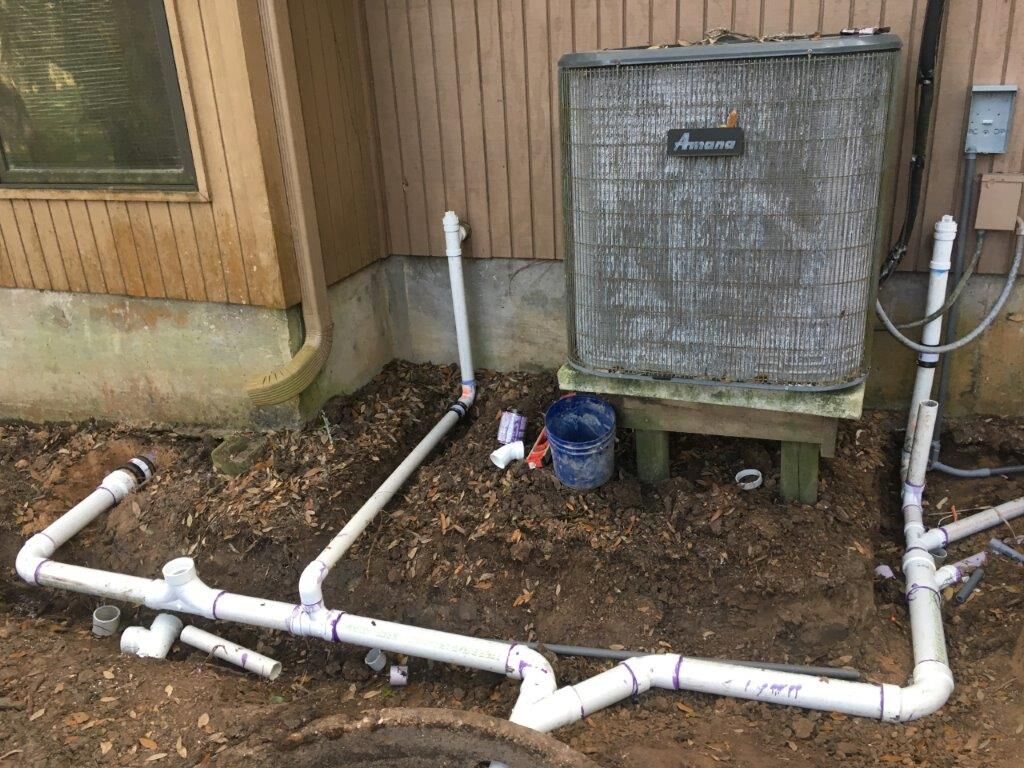
Wastewater leaves the house through a pipe and enters the trash tank. This is where the heavier solids will settle to the bottom while the lighter materials will float to the surface.
Potential Issues
- • Tank integrity
- • Lid integrity
- • Failure of seals around risers, etc.
Step 2: Aeration Process
The wastewater flows from the trash tank into the aerobic treatment unit. Air is pumped into the aeration chamber of the unit, and the wastewater remains there for a relatively long period to allow the microbes to convert the waste into less harmful substances: water, carbon dioxide, and new cells.
Aerobic systems rely on a continuous supply of oxygen to keep the microbes treating the wastewater healthy. Oxygen can be supplied to the wastewater in several ways depending on the brand of system, but can include aerators, compressors or blowers.
Tracking air pressure can significantly affect the longevity of your system.
High Air Pressure
- • More frequent pump-outs
- • High solids build-up in pump tank
- • Premature air pump failure
Low Air Pressure
- • Bad odor
- • Untreated wastewater sprayed onto lawn
Step 3: Clarification
After the aeration process, the effluent now moves into a clarifier, which removes the microbial cells, cell waste, and dead cells from the wastewater. Clarifiers can be oriented vertically or horizontally.
Potential Issues
- • High water usage can cause a buildup of solids, either in top of the clarifier or deep in the chamber, leading to excessive solids being carried over into the pump tank
Vertical clarifiers
The wastewater enters through the bottom of the chamber, and flows upwards, toward the outlet.
Horizontal clarifiers
The wastewater flows laterally from the inlet to the outlet.
Active filtration
Some units incorporate filtration media to filter the biomass from the effluent before discharge.
How settling works
In all clarifiers, the waste particles must be able to settle to the bottom of the tank. For a particle to settle, the downward forces must be greater than the upward forces.
Several factors affect the settling process:
- Gravity
- Pulls the material downward
- Density of the materials
- Determines the rate at which it falls, based on the material's weight
- Buoyancy
- Pushes the materials upward; the water is resisting the object down through it and is actually pushing it up based on the amount of water being displaced
- Water flow speed
- A crucial factor in the design of a clarifier. When the water is moving too fast, fewer particles can settle to the bottom
- Turbulence
- Can interfere with the downward movement of particles
During the clarification process, some materials will float to the surface of the clarifier. These floating materials can be skimmed from the surface of the clarifier.
Step 4: Sludge Return
The solids that settle from the effluent in the clarifier should be returned to a previous component. Usually, the settled material, or sludge from the clarifier, is returned to the treatment tank via a sloped clarifier bottom.
Why sludge return is essential
Sludge return is essential to the treatment process. With sludge return, the microbes in the sludge break down additional wastewater and reproduce, increasing the population to replace dying microbes.
Several systems use a compartmented tank to automatically feed the sludge back to the aeration chamber. In these systems, the rolling motion of the effluent in the aeration chamber will entrain the sludge back into the digestion process.
Other systems that use a separate tank for a clarifier may have a pump to return solids, either to the trash or treatment tank. Additionally, returning the solids to the trash tank may help remove more nitrogen from the system.
Most vertical settling chambers have a passive return process. Solids/sludge pass through the bottom of the clarifier and return to the aeration process. Horizontal clarifiers typically have a separate chamber where solids accumulate and require an active return process.
Step 5: Disinfection
Some pretreatment devices include a disinfection unit as part of the treatment system. In the disinfection process, disease-causing organisms are destroyed or inactivated. This process reduces the concentration of pathogens to an acceptable level. However the wastewater is only disinfected, not sterilized (free of all life).
Before the wastewater enters the disinfection stage, it must be pretreated to remove significant amounts of organic matter and solids. If these are not removed first, they can impede the disinfection process.
Chlorinators (tablet and liquid) and UV light systems serve as secondary treatment devices. Tablet chlorinators are most common.
Tablet chlorinators typically consist of a long narrow tube that holds tablets, which acts as a dispenser for the tablets into the effluent below.
Step 6: Pump Tank and Controls
Pump systems are used in many ways in on-site wastewater treatment systems. For example, they may be used to store and deliver effluent to a spray field or other soil dispersal area.
The pump system consists of a pump tank, pump, discharge assembly, controller, and associated electrical components.

Controller Functions
Pump systems should include a controller to sense water level in the tank, and dose the field when required, or set off alarms if needed. The control panel can be simple or complex depending on the functions it must perform.
Examples of controller functions:
- Automatically turning the pump on and off with a manual override
- Sounding an alarm to indicate problems
- Providing a means of monitoring the system (meters/counters)
- Electronic monitoring and automatic notifications
- Monitoring the air system and tracking air pressure levels to extend compressor's lifespan and ensure proper treatment
Component Reference
Quick reference for each component in your aerobic treatment system.
| Component | Function | Key Maintenance |
|---|---|---|
| Trash Tank | Settles heavier solids and floats lighter materials | Check tank and lid integrity, inspect seals |
| Aeration Chamber | Provides oxygen for microbes to break down waste | Monitor air pressure, check air supply components |
| Clarifier | Removes microbial cells and waste from effluent | Monitor for solids buildup, manage water usage |
| Sludge Return | Returns settled solids to maintain microbe population | Ensure return mechanism is functioning |
| Disinfection | Destroys or inactivates disease-causing organisms | Replace chlorine tablets, check UV lamp if applicable |
| Pump Tank & Controls | Stores and delivers effluent to spray field | Test alarms, verify pump operation, check controller |
Questions about your system?
We'll walk you through how your specific system works and what to watch for. No sales pitch — just the information you need to keep it running well.